The most important decision you’ll make before your first block is signed
The Decision Nobody Talks About Enough
Most first-time validator guides jump straight to node installation — download the binary, configure the genesis file, start syncing. What they skip is the decision that shapes everything that comes after: where does this node actually run?
Your infrastructure choice affects your uptime, your costs, your security posture, your ability to recover from failures, and ultimately your delegators’ trust. Getting this right at the start is significantly easier than migrating later when you have bonded stake and delegators watching your performance.
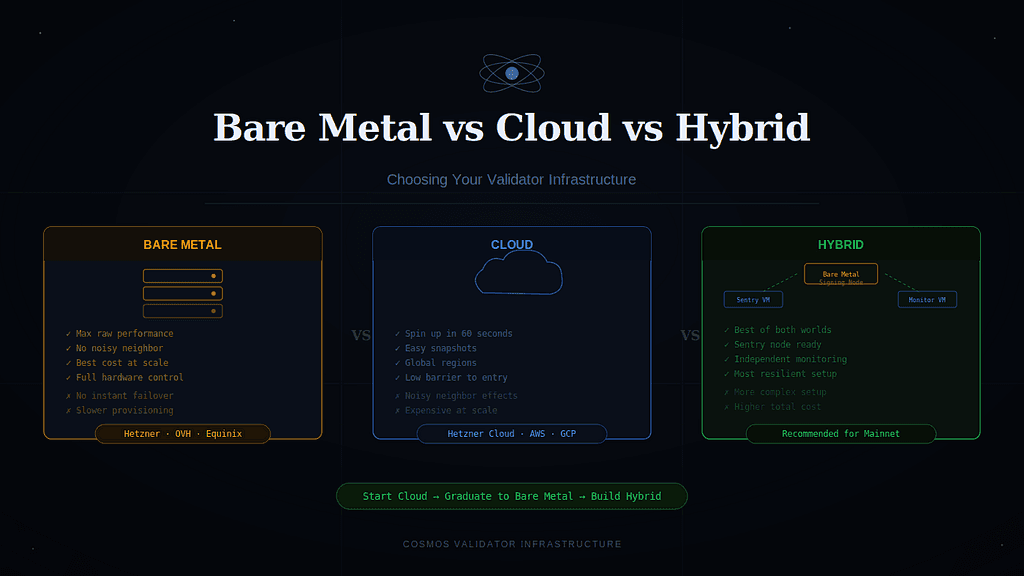
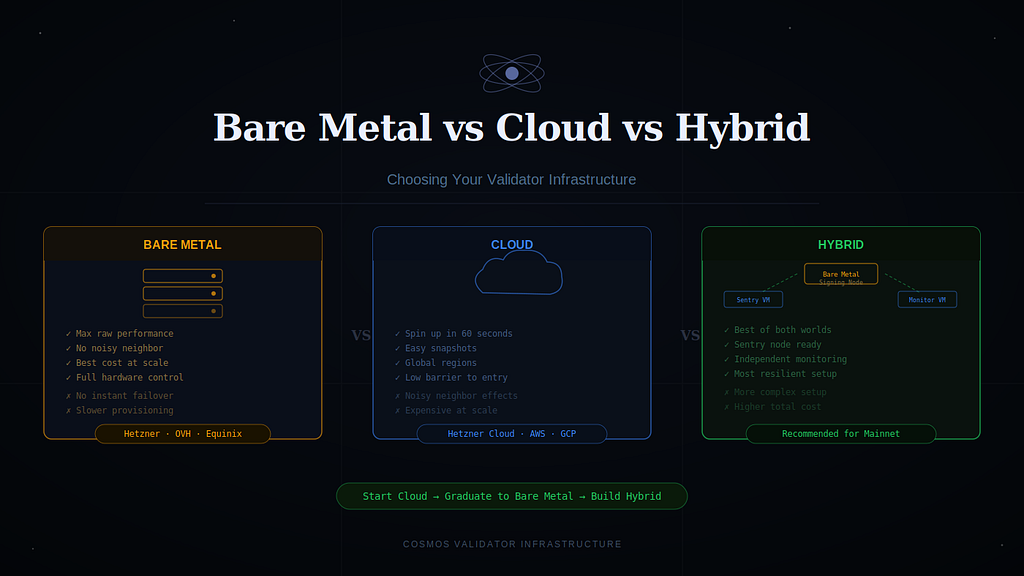
There are three models to choose from: bare metal, cloud, and hybrid. Each has a legitimate place depending on your situation. This guide walks through all three so you can make an informed decision before you spin up your first node.
What You’re Actually Choosing Between
Before comparing, understand what each model means in practice:
Bare Metal — You rent or own a physical dedicated server. No virtualization layer. You get the full CPU, RAM, and NVMe directly. The machine runs your software and nothing else.
Cloud — You run your validator on a virtual machine from a provider like AWS, GCP, Hetzner Cloud, DigitalOcean, or Vultr. The underlying hardware is shared with other tenants, abstracted behind a hypervisor.
Hybrid — Your signing validator runs on bare metal for performance and security. Supporting infrastructure — monitoring server, backup nodes, sentry nodes — runs on cloud VMs.
Bare Metal
What It Is
Bare metal means a dedicated physical server, either self-hosted in your own location or rented from a data center provider. When you rent bare metal, the entire machine is yours — no other tenants, no hypervisor overhead, direct access to the hardware.
Popular bare metal providers used by Cosmos validators:
- Hetzner (Germany/Finland) — most popular in the Cosmos ecosystem due to price-to-performance ratio
- OVHcloud — global presence, competitive pricing
- Latitude.sh — bare metal focused, good for validators
- Equinix Metal — premium, enterprise-grade, higher cost
- Your own hardware — if you have reliable power, internet, and physical security
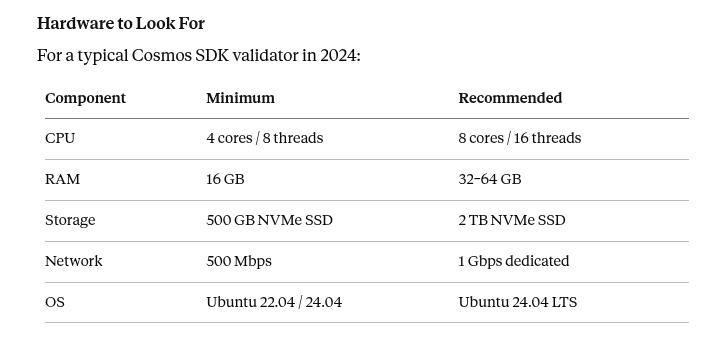
Storage requirements vary heavily by chain. Osmosis and Cosmos Hub grow much faster than smaller chains. When in doubt, provision more than you think you need.
Pros
Raw performance. No hypervisor overhead. Your NVMe is directly attached, not virtualized. For I/O intensive operations — syncing, state transitions, snapshot creation — bare metal is consistently faster than cloud equivalents at the same price point.
Predictable performance. On cloud VMs, you share underlying hardware with other tenants. “Noisy neighbor” effects — where another tenant’s workload affects your CPU or disk I/O — don’t exist on bare metal. Your validator’s performance is yours alone.
Better cost efficiency at scale. A dedicated server at Hetzner with 64 GB RAM and 2 TB NVMe costs roughly €80–130/month (after Hetzner’s 2026 price increases). The equivalent cloud VM configuration (CCX33 on Hetzner Cloud) now sits at ~€138/month after the June 2026 hike — making bare metal even more cost-competitive than before.
No hypervisor attack surface. Cloud VMs introduce a virtualization layer that is an additional attack surface. On bare metal, your threat model is simpler.
Full control. You configure the BIOS, the OS, the networking stack. Nothing happens on your server that you didn’t put there.
Cons
No instant scalability. Need more RAM? You’re ordering a new server or upgrading, not sliding a slider in a dashboard. Provisioning a new bare metal server takes hours to days, not minutes.
Single point of failure. If your bare metal server’s NVMe fails, your power supply dies, or the data center loses power, you’re down until it’s fixed. Bare metal providers don’t offer live migration or automatic failover like cloud providers do.
Management overhead. You’re responsible for everything — OS updates, RAID configuration, hardware monitoring, firmware updates. There’s no managed service layer.
Geographic risk. Your server is in one physical location. A data center issue affects you directly.
Best For
- Validators planning to run long-term with stable hardware requirements
- Operators who want maximum performance per dollar
- Anyone running multiple validators on the same machine
- Teams with the operational maturity to manage raw infrastructure
Cloud
What It Is
Cloud means running your validator on a virtual machine from a provider. The most common choices in the Cosmos ecosystem:
- Hetzner Cloud — cheapest cloud option with solid performance; very popular
- AWS EC2 — most feature-rich, most expensive, global reach
- GCP Compute Engine — strong network performance, competitive pricing
- DigitalOcean Droplets — simple, developer-friendly
- Vultr — good global coverage, straightforward pricing
- Contabo — budget option, inconsistent performance
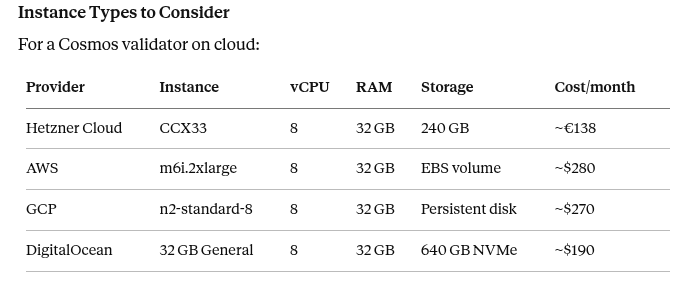
Note the dramatic price difference between Hetzner Cloud and AWS/GCP. However, be aware that Hetzner raised cloud prices significantly in 2026 — the CCX dedicated vCPU tier increased 2x–3x between April and June 2026 due to surging DRAM and NVMe costs. The CX and CAX (ARM) cost-optimized tiers saw smaller increases (~30%) and remain the best value entry points.
Pros
Instant provisioning. A new VM is running in 60 seconds. If your validator crashes and you need a new server fast, cloud wins.
Easy snapshots and backups. Most cloud providers offer one-click VM snapshots. Taking a full server snapshot before a risky upgrade takes seconds.
Global availability. Deploy in any region instantly. Geographic redundancy is simple.
Managed networking features. Load balancers, private networks, floating IPs, DDoS protection — these are available as managed services without complex configuration.
No hardware responsibility. If the underlying hardware fails, the provider migrates your VM. You might see a few minutes of downtime, but you don’t have to replace a drive.
Low barrier to entry. Sign up, pick a plan, deploy. No waiting for hardware provisioning, no data center contracts.
Cons
More expensive for equivalent specs. At AWS/GCP pricing, a properly-sized validator VM costs 3–5x what bare metal costs for the same CPU and RAM.
Performance variability. Noisy neighbor effects are real. I/O performance on shared cloud VMs can spike unpredictably, especially on cheaper providers.
Hypervisor overhead. Virtualization adds latency, especially for disk I/O. On database-heavy workloads like blockchain nodes, this is measurable.
Centralization risk. This matters at the ecosystem level. If the majority of validators for a chain run on AWS us-east-1, an AWS outage in that region can halt the chain. This has happened. Running on cloud, especially the same cloud as everyone else, contributes to this systemic risk.
Vendor dependency. Your validator’s availability depends on your cloud provider’s availability. You’re trusting their infrastructure, their policies, and their pricing decisions.
Storage costs add up. Cloud block storage (EBS on AWS, persistent disk on GCP) is expensive and billed separately from the VM. A 2 TB EBS volume on AWS costs ~$200/month on top of your instance cost.
Best For
- First-time validators who want to get started quickly
- Operators validating on testnets or smaller chains where cost is less critical
- Teams that need to spin up and tear down infrastructure frequently
- Anyone who needs global deployment without managing physical hardware
Hybrid
What It Is
Hybrid is the architecture most serious validator operations converge on: your signing validator runs on bare metal for performance and security, while supporting infrastructure runs on cloud VMs.
A typical hybrid setup looks like this:
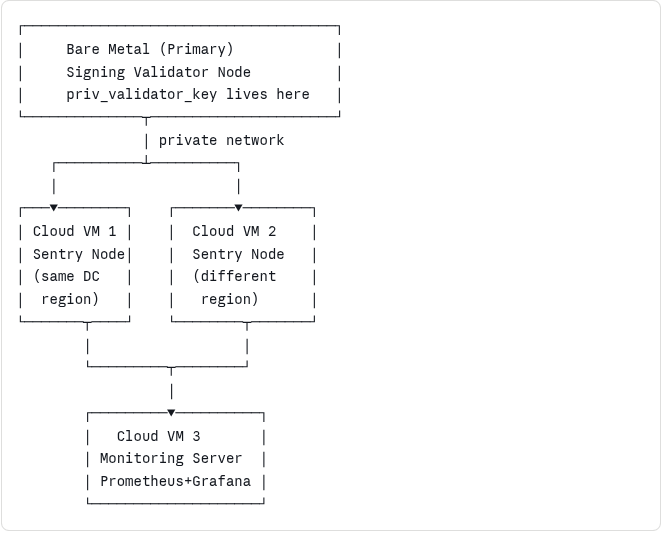
Your validator never exposes itself directly to the public internet. Sentry nodes handle all P2P traffic and forward only to your private validator. The monitoring server watches everything from the outside.
Pros
Best of both worlds. Signing performance and security of bare metal, flexibility and redundancy of cloud for everything else.
Proper sentry node architecture. Sentry nodes protect your validator’s IP from being publicly known. Running sentries on cloud makes them easy to spin up, replace, and distribute geographically.
Independent monitoring. Your monitoring server is on a different provider, different network, different failure domain. If your bare metal server goes down, your monitoring is still up and can alert you.
Cost-effective at scale. Bare metal for your one signing node, small cloud VMs for sentries and monitoring. The signing node does the expensive computation; sentries just relay traffic.
Resilient. A cloud VM failing takes down a sentry, not your signing key. You spin up a replacement sentry in 60 seconds while your validator keeps signing through the remaining sentry.
Cons
More complex to set up initially. You’re managing multiple servers across multiple providers, configuring private networking, and setting up sentry node peering. More moving parts.
Higher total cost than pure cloud (for small operations). Running one bare metal server plus two cloud VMs plus a monitoring VM costs more than a single cloud VM. The cost-benefit makes more sense as you scale.
Requires more operational knowledge. You need to understand sentry node architecture, private peering, and cross-provider networking to set this up correctly.
Best For
- Validators who have outgrown a single cloud VM setup
- Operations running on mainnet chains with real delegated stake
- Anyone who has been jailed once and wants to prevent it from happening again
- Teams running validators on multiple chains who want a repeatable architecture
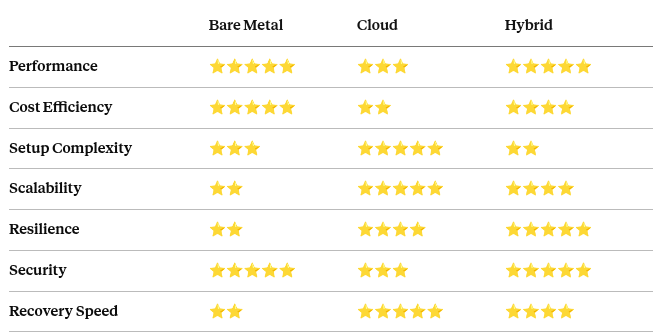
Side-by-Side Comparison
What Should You Choose as a First-Time Validator?
Here’s a practical decision framework:
Start on Hetzner Cloud if:
- You’re validating on a testnet or a smaller chain
- You want to learn the operational side without hardware complexity
- You have limited budget and want to keep costs under €60/month
- You’re not yet sure how long you’ll run this validator
Start on Hetzner bare metal if:
- You’re going straight to mainnet on a major chain (Cosmos Hub, Osmosis, Celestia)
- You’re planning to run this long-term (12+ months)
- You want maximum performance and don’t want to deal with noisy neighbor issues
- You’re comfortable managing a Linux server without managed service guardrails
Plan for hybrid as you grow:
- Once you have delegated stake, add sentry nodes on cloud VMs
- Add a separate monitoring server on a different provider
- This is where most serious validator operations end up within 6–12 months
Provider Recommendations by Use Case
Testnet / learning: Hetzner Cloud CX33 (4 vCPU, 8 GB RAM) — ~€6–7/month on the cost-optimized tier (post April 2026 pricing). Cheap enough to experiment, powerful enough for most testnets.
Mainnet, solo validator, cost-conscious: Hetzner AX52 bare metal (8 cores, 64 GB RAM, 2× 1.92 TB NVMe) — ~€100–130/month (post 2026 pricing adjustment). Still excellent value vs cloud at equivalent specs.
Mainnet, serious operation: Hetzner AX102 or EX101 (bare metal) for signing + 2× Hetzner Cloud CX33 or CAX21 (ARM) for sentries + 1× cloud VM for monitoring. Note: CCX dedicated cloud instances saw 2x+ price increases in June 2026 — CX or CAX tiers are now more cost-effective for sentries.
Enterprise / institutional: Equinix Metal or AWS bare metal for the signing node, AWS/GCP for supporting infrastructure.
A Note on Decentralization
The Cosmos ecosystem has a recurring conversation about validator centralization — and infrastructure choice is a real part of it. When a significant percentage of validators on a chain run on the same provider in the same region, that provider becomes a systemic risk for the chain.
As a validator operator, your infrastructure choice isn’t just a business decision. Using diverse providers, choosing bare metal over hyperscaler cloud when possible, and distributing across geographies contributes to the resilience of the networks you secure.
It’s worth factoring in — not because the chain will penalize you for running on AWS, but because it’s part of what being a responsible validator actually means.
Summary
There’s no universally correct answer. The right infrastructure depends on your chain, your budget, your operational maturity, and how seriously you’re approaching this.
But here’s the practical reality for most first-time validators: start on Hetzner Cloud to learn the ropes, migrate to bare metal when you have real delegated stake, and build toward a hybrid architecture as your operation matures.
The worst outcome is over-engineering your infrastructure before you’ve validated on mainnet, or under-engineering it after you’ve accumulated significant delegated stake. Match your infrastructure to your current stage, and plan for the next one.
Bare Metal vs Cloud vs Hybrid: Choosing Your Validator Infra was originally published in Vitwit on Medium, where people are continuing the conversation by highlighting and responding to this story.